Father Grills Best
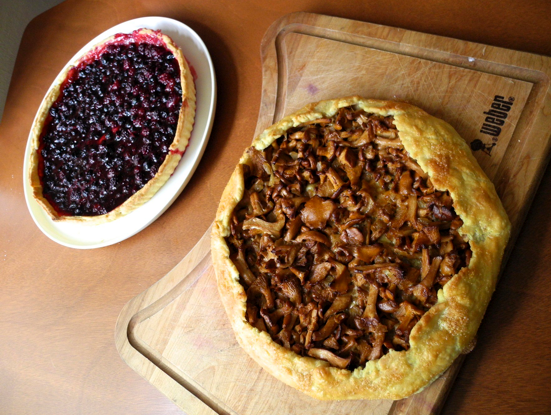
Apologies for the long absence. It was a hellish semester and although I did cook, I was too pressed for time to muck around with the blog. Summer, however, will bring better things and more entries. Coming soon: Latvian berry pies… But in the meantime:
For Father’s Day, K., D. and P. gave me the new cooking implement I’ve been asking for—a heavy, cast-aluminum non-stick griddle/grill. It’s made to fit on top of two burners on a stovetop, and I tried it out in the morning to cook bacon. Brilliant results: a whole pound in one batch. The aluminum is thick and it conducts so well that the surface heats up completely evenly, regardless of the size of the burners beneath. It is made by “Chef’s Design.”
However, this griddle’s true mission in my kitchen is not on the stovetop, but under the broiler.
Back in the dark ages, I used to broil fish (and everything else) on a cookie sheet, usually protected by a layer of aluminum foil. Then one fine day, K. gave me Rick Moonen and Roy Finamore’s superb cookbook Fish Without a Doubt. This opened my eyes to the attractions of Heavy Metal. For those about to cook (wham!), we salute you! Since that transformative moment, I have broiled on cast iron skillets, heated up to a searing temperature under the element before the food is placed onto it. Always set the oven rack at the highest position. The point here is HEAT, baby! Things should sizzle and pop when thrown on the metal. The method works well for just about anything, and you can use either a ridged or a flat skillet—depending on the effect you are after. I do lamb riblets, asparagus, flank steak, etc. But the approach is best for fish, yielding perfectly crispy skin and soft, moist flesh. Over the years, the only limitation that I have found to the approach is the scale of the piece of metal.
Hence the griddle.
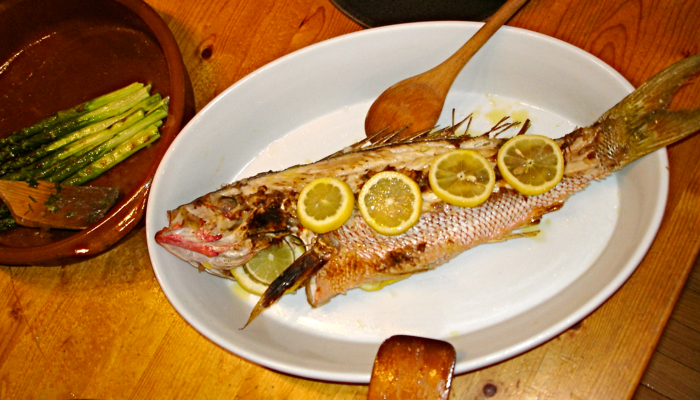
For its maiden voyage, D. decided that we had to cook a whole fish. This red snapper seemed made to order. D. and P. also convinced me, while we were at the fish counter, to get some oysters and clams to eat raw as an appetizer. That’s another story, though.
A simple prep—salt, pepper, olive oil, lemon and lime juice. I also stuffed the cavity with some slices of lemon and lime.
While the fish absorbed the lemon juice for a few minutes, I grilled some asparagus. I peel these larger asparagus shoots—makes for a more tender dish. I find that grilled asparagus retains its emerald green color without any fancy blanching.


Then I threw on the fish and broiled it for about seven minutes a side. Flipping was easy—hooray for non-stick surfaces! I did lose some skin (fish skin, that is) to the heat of the broiler. Not sure what to do about that. Maybe next time I should switch to a hot oven in mid-stream? Or are other fishes thicker-skinned? Or can I rub something on to protect the skin and form a crust—corn starch or rice flour? I’ll have to experiment a bit.

Even with the broken skin, the results were lovely. I threw some more lemon juice, oil, and lemon slices on top of the fish for service. Some girls prefer to pick apart the head. Some go for the tail. To each her own.